Showing posts with label collage. Show all posts

Monday, November 26, 2007

Simic, Collage, Dada

Little Theatre, 11/25/07

For today's class, I had my English 360 (Literary Nonfiction) class read poet laureate Charles Simic's "The Necessity of Poetry" from his 1995 book The Unemployed Fortune Teller. It's a series of anecdotes, apparently disconnected--an example of what is often called "segmented writing." Common motifs in the 35 or so segments are war, parents, clothing, food/drink, reading/writing, male/female relationships. Most of them convey a little mystery or unknown element. It's a verbal collage. Here he's writing about how his violin teacher would sometimes feed him: "'Poor child,' she'd say, and I thought it had to do with my not practicing enough, my being dim-witted when she tried to explain something to me, but today I'm not sure that's what she meant. In fact, I suspect she had something else entirely in mind. That's why I'm writing this, to find out what it was." It's as though Simic writes poetry to make sense of these enigmatic scenes, to explore and elucidate them.
In the August 10, 2006 New York Review of Books, Simic reviewed an exhibition on Dada at the Museum of Modern Art. Simic reviews the origins of Dada in 1916 Zurich--the art/music/poetry/dance exhibitions of Hugo Ball and Emmy Hennings. He writes, "All forms of imitation, the Italian Futurists had already announced, must be despised; all forms of originality glorified. The idea was to make something no one had ever seen or experienced before."
As Simic notes, Kurt Schwitters figures prominently in the Dada movement, which lasted into the early 1920s. Schwitters' openness to all artistic materials, which he called "Merz," is an attitude I find attractive, and his experimentation with various media and endeavors (painting, collage, poetry, architecture, sculpture, music) is reminiscent of William Morris, another artist and writer I admire who also developed a life philosophy that motivated his art.
Recently, I've gotten back into collage and often find myself turning to Schwitters as well as painter/collagist Estaban Vicente though they work in entirely different ways, Schwitters with orginary, often drab, cramped bits of detritus from everyday life, Vicente with bold swatches of color arranged in dynamic ways.
~~~

Saturday, November 04, 2006

House of Sand and Fog

Garbo Collage - April 2006

My English 200 Honors class is reading House of Sand and Fog as we anticipate the campus visit of the author, Andre Dubus III, next week. He'll be at Francis Marion as a headliner in our Fiction Festival, which will also feature Ellen Gilchrist and Dinah Johnson. Rereading the novel, I find myself even more sympathetic to the Iranian family that has purchased a house in California that was repossessed by the county but is still claimed by the original owner, who ignored tax bills, thinking she had already paid them. The novel pits Kathy, a down-and-out cleaning woman, against Behrani, a refugee from Iran who was formerly a wealthy Colonel in the Shah's army but is now struggling to make a go of it in the U.S. Things get complicated when Lester Burdon, a deputy sheriff, takes an interest in Kathy's pitiful plight and then falls in love with her while trying to find a way to extricate himself from an unhappy marriage.
My students seem engaged with the book. I've tried to get them to scrutinize the motives of the main characters, influenced as they all are by past events and complexes. In fact, for their next paper, they'll need to select one character to write on, analyzing his or her actions with the help of secondary sources. In Friday's class we puzzled over issues of perspective in the novel. It largely unfolds as a series of chapters alternating first-person points of view from Kathy and Behrani. Then, we begin to get third-person narrative telling Lester's story. I've challenged the students to think about why there is this shift in narrative strategy toward the end of the novel.

Wednesday, November 01, 2006

Collages

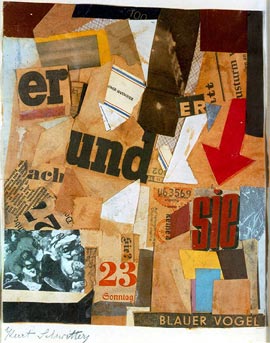
Kurt Schwitters
Blauer Vogel (Blue Bird)Collage c. 1922
8 x 7 in. (20.3 x 17.8 cm)
Collection Mr. and Mrs. Murray A. Gribin, Beverly Hills, CA

Asiana Collage - October 2005
Since discovering the collages of Estaban Vincente and Kurt Schwitters while taking art courses in college, I've been interested in this art form. Schwitters' collages were made up of everyday clutter and detritus he collected and then reshaped into what he called "Merz" constructions. He expanded this concept to architecture and created a "Merz haus." For years I've been making collages, experimenting with patching together ticket stubs, colored paper, wrapping paper, stamps, old envelopes, subway passes--anything two-dimensional that comes to hand. I like the idea that artfully connecting objects with other dissimilar artifacts provides a new way of viewing them--and the visual design itself is worth working for. I've filled notebooks with these paste-ups.
A year or so ago Janne and I saw a display of quilts from Gee's Bend, Alabama at the art museum in Auburn. These distinctive, highly original quilts by a group of rural African-American women have been exhibited all over the country, along with a video showing them at work. They are essentially cloth collages, made of discarded clothing and found scraps.
Perhaps my interest in the collage form is related to my longstanding fascination with journals and diaries and the patchwork quality many of them have. This blog itself is a sort of miscellany, a collage of ideas and visuals.